Sub-Zero Ice Maker
Not Making Ice
Sub-Zero ice maker stopped making ice? Usually a clogged filter, low water pressure, a frozen fill tube, or a failed inlet valve. Same-day Seattle repair.
When a Sub-Zero stops making ice, the usual cause is a clogged water filter, low supply pressure, or a frozen fill tube starving the unit of the 40 PSI it needs to fill the mold, and most of these are cleared the same day in Seattle. Call (425) 532-3360. Our service call fee is $89, applied toward the completed repair.
What you're seeing
The bin is empty, or nearly so, and the cubes that do appear are small, hollow, or cloudy. Some owners see the opposite problem: cubes fused into one solid block, or a mold that overflows and drips water down the back of the unit. Because a Sub-Zero ice maker depends on a chain of small parts working in sequence, the shape and behavior of what you find in the bin usually tells us where in that chain the fault is.
It helps to note when the trouble started. A gradual decline into small, cloudy cubes almost always means water flow, while a sudden stop with a clean, dry mold points at the valve or the module. If you recently changed the filter, moved the unit, or had work done on the water line, mention it. And check the obvious first: the ice maker's power switch and the fill arm or bin sensor are sometimes simply switched off or blocked.
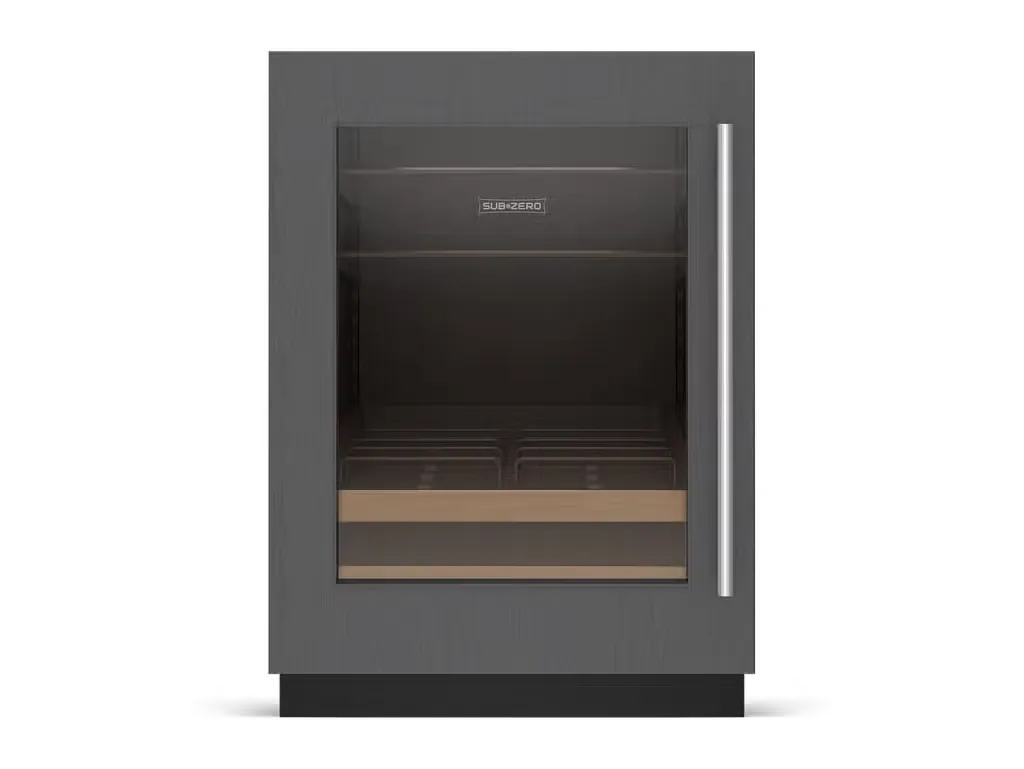
Likely causes, in the order we check them
A clogged or overdue water filter
The filter is the first thing we check because it is the most common cause and the easiest to overlook. Sub-Zero filters are rated for roughly a year, and Seattle tap water carries enough mineral and sediment load that a neglected filter chokes flow to a trickle. Starve the ice maker of water and you get small, hollow, or cloudy cubes first, then no ice at all. A fresh filter is often the entire fix.
Low water pressure at the valve
A Sub-Zero ice maker needs at least 40 PSI to fill the mold correctly. A half-closed shutoff, a kinked supply line, an old saddle valve barely cracked open, or a reverse-osmosis system running without a pump can each drop pressure below that threshold. The mold underfills, cubes come out undersized, and eventually a fill misses entirely. We put a gauge on the line to read the pressure directly.
A frozen fill tube
The fill tube carries water from the valve into the ice mold. If a fill runs slow, or the freezer is running colder than its setpoint, the last of the water in that tube freezes and caps it off, so the next cycle finds the path blocked. You will often see a lump of ice at the back of the mold. We thaw it, but we also find out why it froze, whether a slow-filling valve or a defrost issue, so the same block does not form again a week later.
A failed water inlet valve
This solenoid valve opens on command to admit water. When its coil fails, the valve never opens and no ice forms. When it sticks partly open or its seat wears, it dribbles continuously, which is the real cause behind an overflowing mold, cubes fused into one mass, or water pooling under the unit. A valve that is leaking is worth treating quickly, because that overflow turns into a water-damage problem rather than just an ice problem.
A failed ice maker module or ejector motor
The module is the gearbox that times the freeze, rotates the ejector arm to harvest the cubes, and signals for the next fill. When its motor or gears fail, water can freeze fine but the cubes never eject, or the cycle stalls partway through. On the modular ice makers used in many built-ins and in standalone units like the UC-15I, this is a defined assembly we replace as a unit.
Freezer too warm, or the maker switched off
Sometimes nothing is wrong with the ice maker itself. If the freezer section is not holding temperature because of a separate cooling fault, the mold never gets cold enough to freeze within a cycle. Other times the shutoff arm or the optical bin sensor reads the bin as full, or the ice maker was simply toggled off during a cleaning. We rule these out before condemning any parts.
How we repair it
Start at the water, not the ice maker
Most no-ice calls are water-supply problems, so we begin there. We verify the shutoff is fully open, gauge the line pressure against the 40 PSI minimum, and check the filter's age and condition. A surprising share of calls end right here with a new filter or a fully opened valve.
Thaw and trace an iced-up fill tube
If the fill tube is iced, we clear it and then find the reason behind it, whether a weak fill, a dripping valve, or a freezer running too cold, so the repair actually lasts instead of freezing over again in a few days.
Test the valve and module electrically
We check the inlet valve's coil and the module's motor and switches with a meter rather than swapping parts on a hunch, then run a full harvest cycle to confirm the maker fills, freezes, and ejects on its own.
Replace with genuine parts and verify a cycle
We stock OEM inlet valves, fill tubes, filters, and ice maker modules for the common built-in and standalone units, and we do not leave until we have watched at least one clean harvest drop into the bin.
When to call right away
A no-ice maker is an inconvenience. An ice maker that is leaking is a repair you should not sit on. A water inlet valve stuck open, a cracked fill tube, or an overflowing mold sends water down the back of the cabinet and onto the floor, and in Seattle's built-in installations that means hardwood, cabinetry, and subfloor at risk. If you see water pooling under the unit, cubes fused into a solid mass, or the bin overflowing, shut off the water supply behind or below the unit and book a same-day visit. A dry no-ice problem can wait a day. An active leak should not.
Related problems
Questions about this problem
Why is my Sub-Zero making small, hollow, or cloudy ice cubes?
Almost always a water-flow problem, meaning a clogged filter or low supply pressure. The mold is not getting the volume it needs, so cubes freeze undersized, hollow, or milky with trapped minerals. Start with a fresh filter and confirm the supply valve is fully open. If the cubes do not recover, we will gauge the line pressure and check the inlet valve.
Can I fix my Sub-Zero ice maker myself?
Replacing the water filter and confirming the supply valve is fully open are both safe do-it-yourself steps that resolve a lot of ice complaints. Thawing the fill tube is temporary at best without finding the cause. Anything involving the inlet valve, the module, or the wiring is a technician job, and a leaking valve in particular should be looked at promptly before it causes water damage.
How much does a Sub-Zero ice maker repair cost?
A filter or a supply-side fix is inexpensive, a water inlet valve or fill tube is a straightforward same-day job, and a full ice maker module sits at the higher end while still costing a fraction of replacing the appliance. It all begins with the $89 service call, applied toward whatever repair we complete, so the diagnosis pays for itself.
How long after a repair before my Sub-Zero makes ice again?
A healthy Sub-Zero ice maker runs a harvest roughly every 90 minutes to two hours, so expect the first full cubes within a couple of hours and a filled bin within a day. If you have just changed a filter or reopened the water, run and discard the first batch or two, since the initial cubes can be small or cloudy until the line purges.
My Sub-Zero has a separate ice maker drawer. Is that different?
The dedicated ice makers, such as the UC-15I and the clear-ice units, use the same fundamentals of a water supply, an inlet valve, and a harvesting mechanism, but they add their own pump, reservoir, and sometimes a condenser and drain. They tend to collect scale and clog their drains on top of the usual valve and module faults. We service both the built-in makers and the standalone drawers.