Sub-Zero Refrigerator
Not Cooling
Sub-Zero warm but freezer still cold? Usually a dirty condenser coil or failed evaporator fan. Same-day diagnosis and repair across Seattle.
On a Sub-Zero, a warm refrigerator while the freezer stays cold points almost every time to a dirty condenser coil or a failed evaporator fan in the fresh-food circuit, and both are usually fixed the same day in Seattle. Call (425) 532-3360. Our service call fee is $89, applied toward the completed repair.
What you're seeing
You open the door and the milk is warmer than it should be, or the butter has gone soft, while the freezer below still holds ice cream firm. On a dual-refrigeration Sub-Zero that split is the most useful clue you can give us. The fridge and freezer run on two completely separate sealed systems, so one side can lose cooling while the other works perfectly. A built-in that is warm in both sections tells a different story, one that usually points at the condenser or the compressor both circuits depend on.
Some owners notice the cabinet seems to run constantly while the food stays only slightly cool. Others see a temperature alarm or an EC code on the display of a newer Designer or 700-series unit. Before you call, note whether the compressor is humming, whether you feel any air moving inside, and roughly how warm each section actually is. Those three details usually tell us which part failed before we even arrive.
Likely causes, in the order we check them
Dirty condenser coil
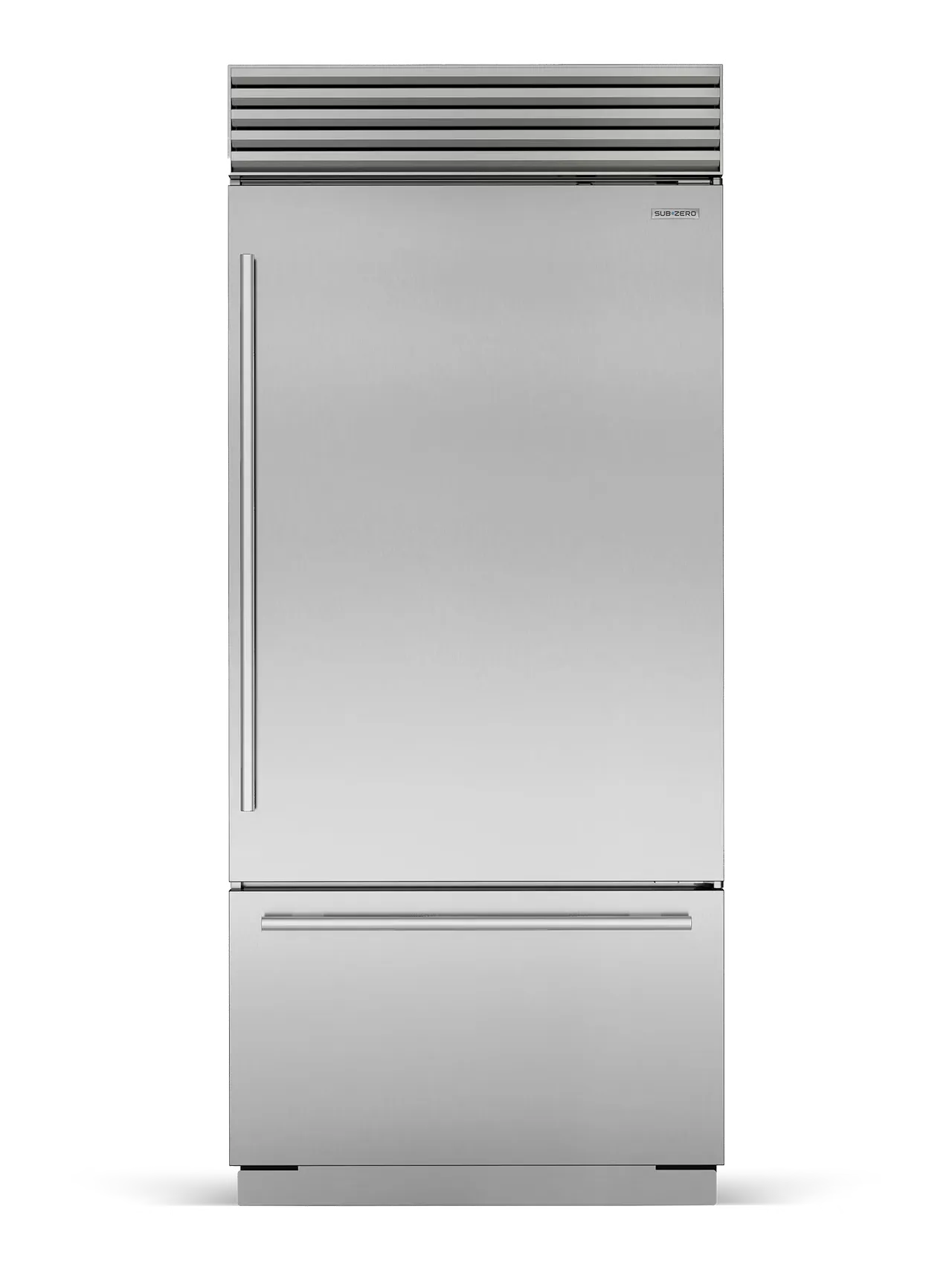
This is the single most common preventable cause of lost cooling. On most built-ins the condenser coil sits behind the grille at the very top of the cabinet, where it collects dust, pet hair, and fine household lint. Once it clogs, the compressor can no longer shed heat, cooling capacity drops, and the whole cabinet slowly warms. Sub-Zero asks you to clean that coil every six to twelve months. Skip it long enough and the system eventually throws an EC50 or an EC40 compressor-overrun code as it fights to keep up.
Failed evaporator fan motor
Each sealed system has an evaporator fan that pushes cold air off the coil and into its compartment. When that motor seizes or its bearing wears out, the coil still gets cold but the air never moves, so one section warms while the compressor keeps running. This is exactly why a Sub-Zero can hold a rock-hard freezer and a warm fridge at the same time. You will sometimes hear a chirp or a rattle from the back of the compartment, and sometimes nothing at all where the fan used to hum.
Condenser fan failure and overheating
The condenser fan cools the compressor and the condenser coil. If it stops, the compressor overheats, trips its thermal overload, and cooling comes and goes as the unit cycles on protection. On models with onboard diagnostics this reads as an EC50 overrun on the fresh-food side, and sustained overheating drives the EC40 compressor-overrun code. A dead condenser fan is one of the fastest ways to cook an otherwise healthy compressor, so we treat it as more than a nuisance.
Iced-over evaporator from a defrost failure
When the defrost heater, sensor, or control fails, frost builds on the evaporator coil until it becomes a solid block of ice that blocks all airflow. The symptom looks like weak cooling with heavy frost at the back of the freezer, often paired with an EC24 defrost code. Because the compressor is still running, owners assume the sealed system is fine, but no air can get past the ice. We confirm it by forcing a manual defrost and watching whether the coil clears.
Worn door gasket or a door that will not seal
A tired magnetic gasket, a sagging door, or something as ordinary as a jar blocking the door lets warm, humid Seattle air leak in continuously. The compressor runs longer and longer trying to keep up, the interior never reaches setpoint, and frost or condensation forms near the leak. Gaskets harden and shrink with age, and on 600-series built-ins from the 1990s they are a routine replacement rather than a rare failure.
Sealed-system refrigerant loss or a weakening compressor
Least common but most serious is a refrigerant leak, a restricted capillary, or a compressor losing pumping strength in one of the two sealed systems. Here the compressor may run nonstop with almost no cooling, or short-cycle while the cabinet stays warm. This is the one repair that legally requires EPA 608 certification to open the system, and it is where a shop that actually rebuilds sealed systems saves you from a needless full replacement.
How we repair it
Read the split before we touch anything
The first question is which sections are warm. A warm fridge with a cold freezer, both warm, or intermittent cooling each point at a different part of the system. We check each compartment's actual temperature, pull any EC codes stored in the control, and listen to what the compressor and fans are doing before a single panel comes off.
Test the coils, fans, and airflow
We inspect and clean the condenser coil, confirm both the condenser and evaporator fans spin freely and draw the correct current, and check for an iced evaporator. Most cooling calls are solved right here with a coil cleaning, a fan motor, or a defrost part, and never require opening the sealed system.
Verify the sealed system properly
If the fans and defrost check out, we measure the compressor's performance and look for the signatures of a refrigerant leak or a restriction. We only call it sealed-system work when the evidence is there, because that finding decides whether you spend a few hundred dollars or weigh a full rebuild.
Repair with genuine Sub-Zero parts
We carry the common evaporator and condenser fan motors, gaskets, defrost heaters, and control boards for the 600, 700, and BI series, so most cooling failures are wrapped up in a single visit. Sealed-system rebuilds are done to spec under EPA 608 and extend the unit's life by a decade or two.
When to call right away
A Sub-Zero that is warm in the fresh-food section is on a clock. Most refrigerated food becomes unsafe after about four hours above 40 degrees, and a full built-in can hold hundreds of dollars of groceries. More urgent still is a compressor running hot because a condenser fan quit or the coil is packed with dust, since every hour it labors overheated shortens its life and pushes you toward a far costlier sealed-system repair. If both sections are warming, the cabinet runs constantly, or you smell anything hot near the grille, treat it as same-day. We hold same-day slots open across Seattle for exactly this.
Related problems
Questions about this problem
Why is my Sub-Zero freezer cold but the refrigerator warm?
Because a Sub-Zero uses dual refrigeration, meaning two separate sealed systems. A cold freezer with a warm fridge tells us the freezer's system is healthy and the fresh-food side has the problem, most often a failed evaporator fan, an iced evaporator from a defrost fault, or a dirty condenser coil affecting that circuit. It rarely means you need a whole new refrigerator.
Can I fix a Sub-Zero that is not cooling myself?
You can safely do the one thing that prevents most cooling loss, which is to pull the grille and vacuum the condenser coil clean. Beyond that, fan motors, defrost parts, and control boards require disassembly and electrical testing, and anything involving refrigerant is illegal to open without EPA 608 certification. If the coil is already clean and it still will not cool, it is time for a technician.
How much does it cost to fix a Sub-Zero that will not cool?
It depends entirely on the failed part. A coil cleaning or a single fan motor is a modest same-day repair, a defrost or control-board fix is mid-range, and a sealed-system rebuild is the top end while still landing far below the cost of replacing a built-in. Every diagnosis starts with our $89 service call, which we apply toward the completed repair so the visit is never wasted money.
What does an EC40 or EC50 code mean on my Sub-Zero?
EC40 and EC50 are compressor-overrun warnings — EC40 on the freezer circuit and EC50 on the fresh-food — both the system telling you it cannot shed heat fast enough. In the field they very often trace back to a dirty condenser coil or a dead condenser fan starving the compressor of cooling air. Address them quickly, because sustained overheating is what damages the compressor itself.
How long can food stay safe in a warm Sub-Zero?
Roughly four hours once the interior climbs above 40 degrees, and less if the door has been opened. If the freezer is still cold, move perishables down into it as a stopgap. If both sections are warming, get the food into a cooler and book a same-day visit, because the cabinet will not recover until the underlying fault is fixed.